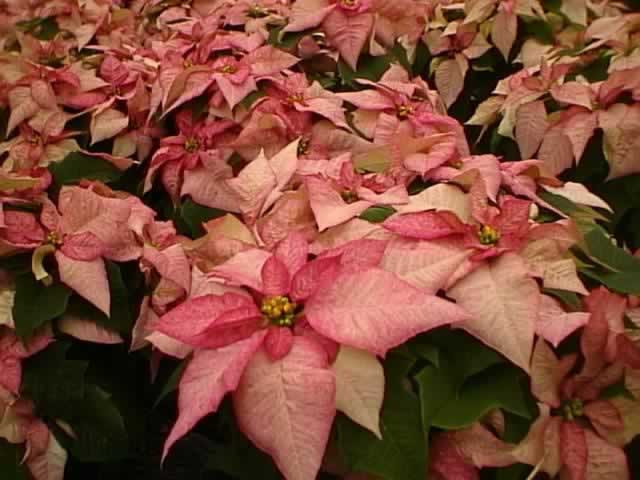
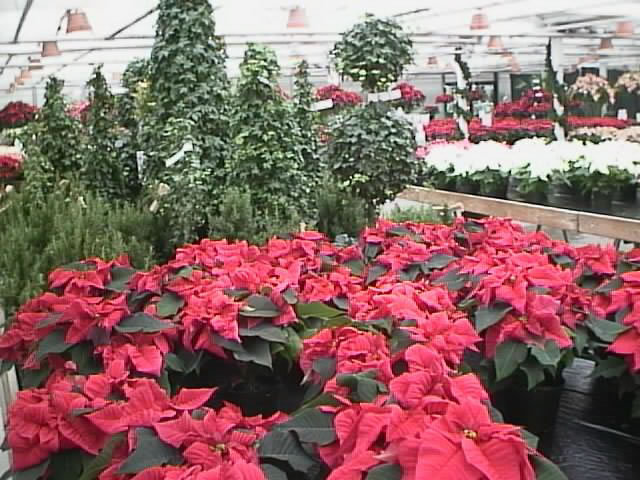
How to Grow and Care for Poinsettia Plants
Euphorbia pulcherrima
          
Ranee wrote and asked "Where did the Poinsettia come from, it's original place?"
"How do you care for one?"
|
|
Growing Requirements for Poinsettia Plants
Poinsettias require medium to bright light, but never full sun.
They prefer to be kept on the cool side, 65°-70° during the day and 55°-60° at night.
They will lose leaves if they are exposed to temperatures below 50° or above 80°.
Keep your Poinsettia as far as possible from heat sources or cold drafts.
Poinsettias prefer moderately moist soil, so when the soil begins to feel dry to the touch,
add enough water so the excess drips out the drain holes, but never allow the plant to sit in water.
Feed your Poinsettia every 2 weeks with an all purpose liquid 10-10-10 fertilizer while the plant is actively growing.
Poinsettias are perennials, so it is possible to keep them growing from year to year.
Forcing Poinsettia Plants to Re-bloom
|
|
The Poinsettia is short day plant that blooms in reaction to the natural shortening of the days in fall.
In order for you to 'set' the time of blooming for Christmas, your plant must be subjected to 14 hours of total darkness per day
with a night temperature of 50° F. beginning in mid September.
This can be accomplished by placing your plant in a closet or unlit room,
or by covering the plant with black cloth, black plastic frame or a cardboard box.
At this stage, ANY light, even turning on a light bulb in the room for a few seconds will delay the bloom for up to a day!
Your Poinsettia plant should be returned to the light each day and given a minimum of 4 hours of direct sun.
Once the bract color has begun to show, start feeding your Poinsettias
every 2 weeks using a high nitroger fertilizer.
A Short History of Poinsettias in Cultivation
Poinsettia Plants were first brought into the United States in 1825 by Joel Robert Poinsett,
while he was serving as the first U.S. ambassador to Mexico.
He found the plants growing wild on a hillside near Taxco, Mexico.
When he returned to the United States, he sent the plants to different botanical gardens all around the world.
The first Poinsettias were sold for Christmas in the US about 1850. Today there are over 60 different varieties of Poinsettia plants in 20 or more solid and variegated colors, resulting in the sale of over 65 million Poinsettias in the United States each year! |
|
See also: How to Grow and Care for Poinsettia Plants in Your Garden
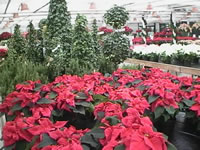
Poinsettias
Euphorbia pulcherrima
 |
 |
The NBCi Directory team is pleased to inform you that a site you submitted to NBCi LiveDirectory:
http://www.thegardenhelper.com/poinsettias.htm
has distinguished itself as one of the most popular LiveDirectory sites in its category.
In recognition, we have promoted the site to NBCi's premium Directory http://edition.nbci.com.
Please accept our congratulations on your submitted site being including among the best sites on the Web!
Sincerely, The NBCi Directory Team |
|
|
|
Search The Garden Helper: