Everything you Need to Know about Growing Twinspur Plants
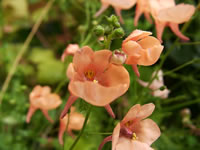
Diascia barberae
       
Twinspurs are a vigorous growing, tender perennials that are closely related to the Snapdragon.
They bear small, light green, heart shaped leaves and will grow from 6"-12" tall, forming 8"-20" clumps.
From late spring until early fall, they produce dense clusters of bright pink or salmon colored,
1/2"-3/4", spurred flowers which rise above the foliage.
Because they are only hardy in USDA zones 8-10, Twinspurs are most often grown as annual plants.
Twinspur plants are excellent as ground covers, in rock gardens or borders, and are well suited for growing in containers.
|
|
Growing Requirements for Twinspur Plants
Twinspurs grow and flower best when they receive full sun for most of the day,
but in hot summer regions, they should be grown in partial shade.
Twinspur plants thrive in evenly moist, organically rich, well-drained soil.
They will not survive heavy, wet soil in the winter.
Prepare the planting hole by mixing in a shovel full of compost
or other organic material at planting time.
Water regularly and thoroughly throughout the summer months.
Deadhead spent flowers regularly to prolong the blooming season.
In areas where night time temperatures remain above 75°, Twinspurs will stop blooming,
but they will flower again as soon as the nights are cooler again.
Plants that stop flowering can be sheared back to about 4",
to tidy them up before their next round of blooms.
|
|
Take precautions to protect your Twinspur from slugs and snails.
Propagating Twinspurs and Growing them from Seed
Twinspurs can be propagated with softwood cuttings
taken in the spring or at mid-summer.
Twinspur seeds can be sown directly in the garden in the fall,
or in early spring, a few weeks before last frost date in your area.
Start your seeds indoors 8-10 weeks before your last frost date, for planting outdoors after the soil warms and daytime temperatures reach 60°.
Maintain a temperature of 60°-65° within the growing medium until germination, which takes about 2 weeks.
Pinch the tips of seedlings when they are 2½"-3" tall.
|
|
Twinspur
Diascia barberae
|
|
|
|
|
Search The Garden Helper:
