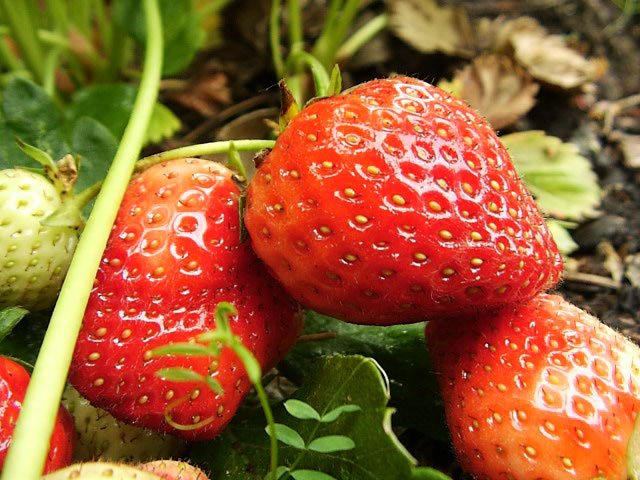
Planting time is determined by your plant hardiness zone.
In areas where the winters are severe (USDA zones 1-5), dormant plants should be purchased
and set out in early spring, while temperatures are still cold.
In mild winter areas, it is best to plant in the fall, giving you a crop the first spring.
Flower buds should be kept picked off during the first month or so to allow the plant
to establish itself and develop strength for a big crop.
Planting Strawberries
Strawberry plants can be grown in rows or mounds. The mounding method is best for everbearing types or in areas where drainage is a problem.
In rows, the plants are generally set 18 inches apart,
with the first runners positioned with 6 inches of spacing between them.
Only allow a few runners per plant, after which additional starts are cut off.
In mounding, the plants are set at about 12-15 inches apart.
Everbearing Strawberries should not be allowed to produce runners until the mother plant is exhausted, and you wish to create plants for future use.
Strawberry plants need to be set carefully.
The crown must be above the soil level, and the uppermost roots should be 1/4 inch below the soil level. |
|
A complete plant fertilizer should be applied alongside each row, or mixed into the soil if mounded. Water in the fertilizer well.
A heavy mulch of sawdust, grass clippings, or even plastic sheeting should then be added to prevent weeds and to conserve moisture. Everbearers will need an inch of water each week during growing season.
The plants should be fed again at mid season.
Strawberry Diseases and Pests
When making your choice of varieties, be aware that some may be more susceptible to viruses than others, and therefore may be better for one area than another.
Strawberries are subject to fruit rot (botrytis), root rot (red stele), and fungus (verticillium wilt). Consult your nurseryman about which varieties may
not be appropriate for your area.
Aphids and spider mites may be a problem, so the plants should be dusted or sprayed to control these.
Slugs and snails may ravage your plants, so controlling them is also very important.
Pesticides and fungicides should never be applied to the plants once the fruit has set.
ALWAYS read the package carefully before using any chemicals in your garden or elsewhere!!!
Varieties of Strawberry Plants
Everbearing Strawberries |
| 'Brighton' |
Large flowers and berries, good in hanging baskets |
| 'Chandler' |
Large, juicy berries better grown in dryer climates |
| 'Fern' |
Medium sized sweet berries, good for canning and freezing |
| 'Fort Laramie' |
Large berries, excellent yield, very hardy |
| 'Hecker' |
Small flavorful berries, very hardy |
| 'Lassen' |
Medium berries, 1 spring and 1 fall crop, good for freezing |
| 'Ogallala' |
Hybrid with wild strawberries, early producer |
| 'Ozark Beauty' |
Large berries, mildly sweet, widely adaptable |
| 'Quinault' |
Large tasty berries, my favorite |
| 'Rainier' |
Large berries, a Northwest favorite |
| 'Selva' |
Produces late, but heavy, for dryer areas |
| 'Sequoia' |
Medium, delicious berries, heavy producer |
| 'Tillikum' |
Small berries, but heavy producer |
| 'Tristar' |
Large berries, flavorful, good producer |
June Bearing Strawberries |
| 'Benton' |
Medium berries, very flavorful |
| 'Douglas' |
Medium berries, heavy producer, very hardy |
| 'Hood' |
Large berries, better for jams or fresh use |
| 'Northwest' |
Big beautiful berries, needs good drainage |
| 'Olympus' |
Medium berries, vigorous grower |
| 'Puget beauty' |
Medium berries, very sweet, second light crop later |
| 'Shuksan' |
Medium berries, good in alkaline soil areas |
| 'Tioga' |
Medium berries for freezing, for dryer areas |
| 'Totem' |
Medium berries, very flavorful |
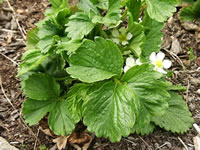
Strawberries
Fragraria ananassa
 |
 |
Happy snacking!
|