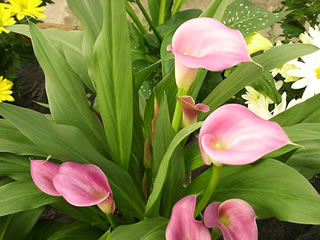
Repotting Calla Lilies, African Violets,
and other House Plants
I received a beautiful Cala Lily from a friend. Yellow blooms. I have only had it for about two weeks. It is still thriving with new leaves forming. However, it is twice as tall as the container and the stems near the soilare turning yellow.
Do I repot and how? Do I cut the blooms back at any time?
I have an African Violet that I am sure needs repotting. The roots are coming above the soil.
I am reluctant to repot/divide because I have killed plantsbefore. Help!
Thanks, Vallery, Outer Banks, NC
|

|
Repotting your Calla Lily
If your lily has become root bound, it is easy enough to move it to the next larger size pot by simply removing it from its pot and potting it up.
Unlike many plants it is not necessary to loosen or disturb the roots, just place it in the pot and add sufficient soil to fill it to within 3/4 of an inch from the rim.
When they are grown in pots Calla lilies (Zantedeschia) should be kept constantly wet and should be given a weak solution of liquid plant food every 3 weeks while they are showing signs of new growth.
Grow them in a sunny window at a temperature of about 70° F.
Remove the flowers when they begin to fade. When the plant has finished blooming, allow the foliage to mature and gradually reduce watering until the leaves have all died back.
Allow the tubers to rest for two or three months in the dry pot. The tubers of the yellow calla lily (Zantedeschia elliottiana) should be left exposed in a warm, dry room for 3-4 weeks.
After the ripening period, the tubers can again be repotted in fresh soil, and the process begun again. Water sparingly until the new growth is well above the surface of the soil, then keep the soil wet again.
|
|
Do not feed until the plant has again become root bound.
The ripened tubers can also be planted outside once the temperatures and soil have warmed in the spring, but because they are frost tender, they will have to be dug up in the fall.
Repotting African Violets
When repotting houseplants such as your African violet (Saintpaulia species) it is best to only increase the pot size by an inch or so.
Always use a good commercial potting soil rather than dirt out of the garden to prevent insects and disease.
Remove the plant from its old pot and use your fingers to gently loosen the outer roots from the root ball.
Place enough soil in the bottom of the pot to bring the plant up to its original soil line, and then add the remaining soil to fill the pot to within 3/4 of an inch from the rim.
Water it thoroughly so that the soil fills in any air space around the plant, after which you may have to add a little more soil.
Do not fertilize the plant until it shows signs of renewed growth.
When you are working with African violets use care not to touch the stems more than necessary, because they are by far more succeptable to damage than either the leaves or roots.
|
|
When feeding African violets, always use a fertilizer that is specifically formulated for them.
If it is at all possible violets should be watered from the bottom, by soaking, because they are prone to crown rot.
|
|
Search The Garden Helper: