How to Grow and Care for Flamingo Flower Plants
Anthurium species
        
Flamingo Flower plants are durable and fairly easy to grow house plants that will thrive for many years under ideal conditions and can even survive for a year or two in the most adverse situations.
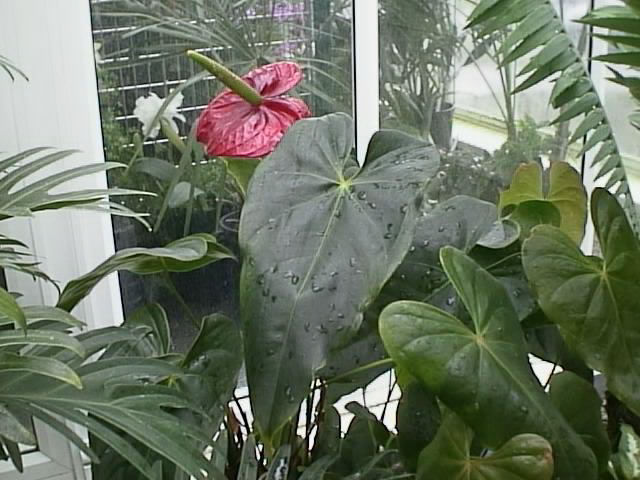
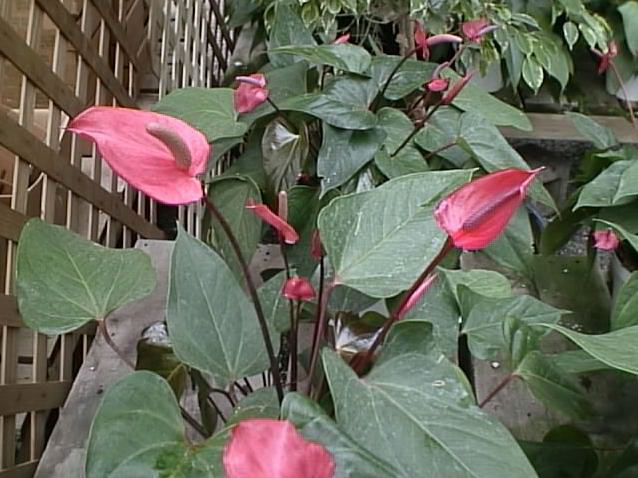
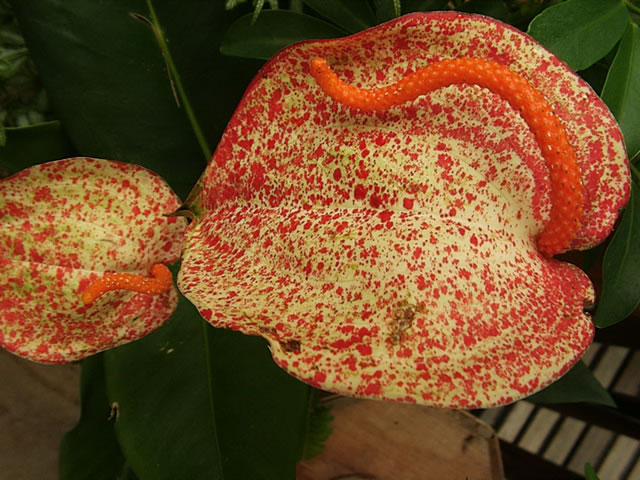
They have large, deep green, lance or heart shaped leaves and produce long lasting, brightly colored,
heart shaped flower bracts, resembling those of their close relative, the Calla Lily.
Flamingo Flowers begin blooming in early February, just in time for Valentines Day!
|
Growing Requirements for Flamingo Flower Plants
Anthurium plants are native to tropical regions of the Americas and are only hardy in USDA zones 11-12.
The other 99% of us will just have to be content with growing and enjoying them indoors.
 |
As with most other house plants, you will want to replicate their native growing conditions as closely as possible when growing Flamingo Flowers indoors. These are jungle plants that live protected from the sun by a canopy of trees. In the home, Flamingo Flowers should be grown in a draft free spot where they will receive lots of bright, indirect light but NEVER full sun.
They prefer temperatures between 78°-85° during the day, with night temperatures about 10° cooler. Plant growth and flowering will cease at temperatures below 65°. Temperatures above 90° can cause the foliage to scorch and can even be fatal.
Ideally, the humidity should be 80% or higher. Insufficient humidity can cause your Flamingo Flower's foliage to lose its glossy sheen.
Humidity can be increased by setting the planter on a tray filled with moistened pebbles or placing moist, fresh sphagnum moss around the plant.
A strategically placed aquarium will help raise the humidity as well.
Regular misting or sponging the leaves off with room temperature water is also very beneficial. |
|
Flamingo Flower plants should be watered regularly and thoroughly, allowing the soil to only dry slightly before watering again.
Never allow the planter to set directly in water for more than a few minutes.
Over watering can quickly cause the leaves to turn yellow, which if not corrected immediately,
will be followed shortly by root rot, which is almost always fatal.
Feed your Flamingo Flower yearly at the beginning of the growing season, using a slow release, granular fertilizer,
OR feed every month while actively growing, using a ¼ strength dilution a soluble, 3:1:2 ratio fertilizer.
over-fertilize your Anthurium. This is one situation when less is best!
Remove spent flower bracts as soon as they begin to fade and turn brown, to encourage continued flowering.
Anthuriums are particularly susceptible to attacks from aphids, thrips and scale insects, as well as mealy bugs.
Inspect your indoor plants regularly to control these house plant pests as well as other common plant problems.
Flamingo Flower plants should be re-potted every 2-3 years.
When re-potting your Anthurium, use care to avoid damaging the fragile roots.
Choose a high quality, peat moss based potting mix, with a high perlite content to ensure proper drainage.
Propagating Flamingo Flowers and Growing them from Seed
Flamingo Flowers can be easily propagated by dividing the root structure when you repot your plant, making sure that each division contains at least two rhizomes.
Anthurium seeds need to be sown while they are still fresh and moist.
Sow seeds indoors in individual 4" pots, then cover the pot with a mason jar to retain high humidity. Maintain a constant temperature in the growing medium of 80° until germination is complete. Germination takes 20-30 days.
|
|
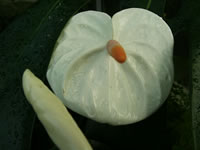
Flamingo Flowers
Anthurium andraeanum
 |
 |
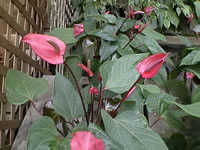
Anthurium antioquiense |
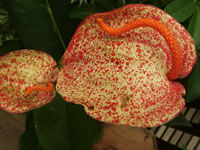
Anthurium scherzerianum |
|
|
|
|
Search The Garden Helper: